YUAN Cuts Edge AI Memory Usage by 20% to Run on Jetson Orin NX 8GB, accelerating the deployment of smart community analytics

Combining a lightweight vision model, YUAN moved its cross-camera smart community analytics from a 16GB to an 8GB platform
Cameras across residential communities capture activity in lobbies, shared spaces, multipurpose rooms, and elevators. Reviewing an incident often requires operators to switch between feeds and manually piece together what happened. Cross-camera analytics helps connect these views, but processing multiple video streams places additional demands on edge compute and memory. YUAN addresses this challenge with a cross-camera analytics solution running on NVIDIA Jetson Orin NX 8GB with NVIDIA JetPack 6.2, supporting four simultaneous 1080p video streams per device. By combining a lightweight AI model, NVIDIA TensorRT FP16 inference, and streamlined system services, YUAN reduced AI model memory usage from 4.4GB to 3.5GB—a 20.5% reduction. Rank-1 accuracy changed from 95.2% to 94.6%, a decrease of 0.6 percentage points.
Bringing Multi-Camera Analytics to Memory-Constrained Edge Devices
Cross-camera analytics continuously detectsobjects, extracts visual features, and associates trajectories across camera views. These workloads share memory with video decoding, stream buffers, the operating system, and background services.
On an 8GB edge device, reducing model and system memory overhead is essential to balancing matching accuracy with deployment requirements. YUAN optimized both layers to make a lower-memory platform a practical option for multi-camera analytics in residential communities.
Connecting Camera Views for Faster Event Review
The YUAN solution combines information from cameras across different areas through three processing stages:
1. Object detection and single-camera tracking: Detect objects and establish movement trajectories within each camera view.
2. Cross-camera association: Match trajectories across views using visual appearance, timestamps, and spatial relationships between cameras.
3. Movement record integration: Combine associated trajectories into records that operators can query when reviewing an event.
For example, when reviewing an event spanning a lobby, shared space, and elevator, operators can use the associated records to find relevant locations and the last observed camera view. This narrows the footage requiring manual review. Association quality depends on lighting, occlusion, viewing angles, and camera placement.
Alongside its work in cross-camera analytics, YUAN is collaborating with EverMira AI Tech, a provider of physical AI platforms and data-driven operations solutions, to advance autonomous robotic patrols in smart communities. By combining YUAN's edge AI computing and machine vision technologies with EverMira's expertise in embodied AI robotics, the collaboration enables robots to work with existing cameras and IoT systems to conduct event-triggered inspections and support smarter community operations.YUAN Optimizes the Model and System Software
Lightweight Models and TensorRT FP16 Inference
YUAN uses a lightweight AI model with NVIDIA TensorRT and FP16 half-precision inference to reduce the model's runtime memory requirements. Comparing Rank-1 accuracy before and after optimization helps quantify the impact on person feature matching.
Streamlined BSP, Jetson Agent Skills and System Services
YUAN also tailors the board support package (BSP), Jetson Agent Skills and system configuration to deployment needs by:
• Disabling graphical interface services that the application does not require.
• Disabling nonessential background services. These changes reduce resident system memory usage, leaving more capacity for video processing and AI analytics. The services disabled depend on device functionality and maintenance requirements.
Measuring Memory Savings and Matching Accuracy
The optimized deployment supports four simultaneous 1080p streams on a single NVIDIA Jetson Orin NX 8GB device, with the following model-level results:
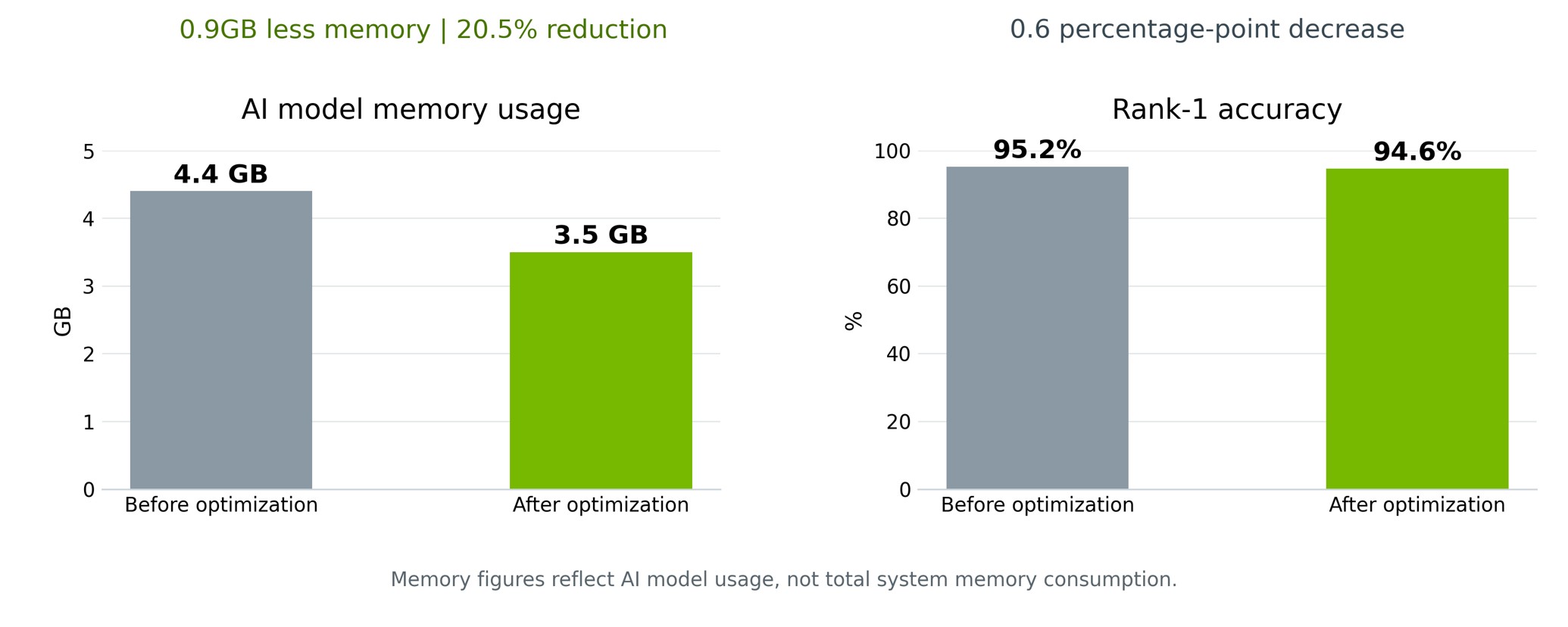
Figure 1. AI model memory usage and Rank-1 accuracy before and after optimization.
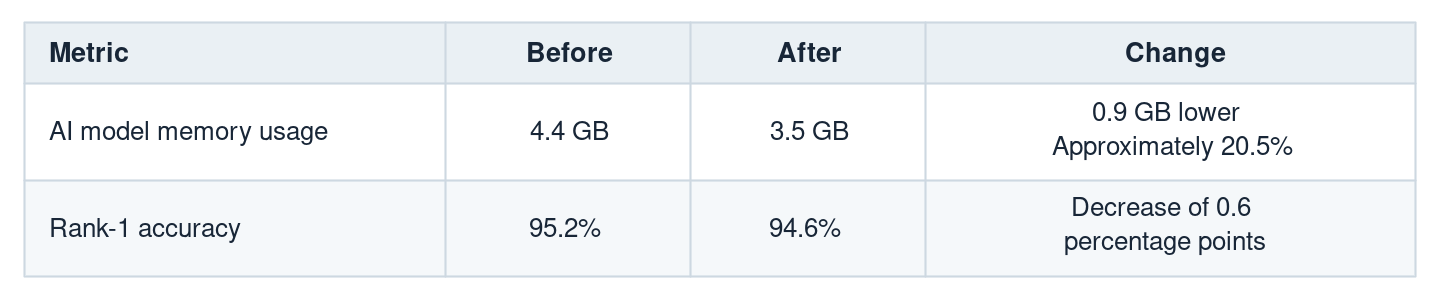
Interpreting the Results
Rank-1 accuracy measures how often the top-ranked candidate is the correct match in a person feature retrieval evaluation. It does not represent the end-to-end cross-camera tracking success rate across all deployment environments.
The memory figures represent AI model usage, rather than total system memory consumption. Moving from an NVIDIA Jetson Orin NX 16GB platform to an 8GB platform is a separate change in hardware capacity; the 20.5% reduction describes the model's memory usage.
Frame rate, latency, and peak system memory usage require validation against stream frame rates, the number of people in view, and site conditions. Hardware cost and power benefits also depend on the final deployment configuration.
Extending the Approach to More Edge AI Applications
YUAN's optimization combines lightweight models, TensorRT inference, and system service configuration to reduce memory requirements while retaining Rank-1 accuracy close to the original result.
The same approach can inform multi-camera analytics deployments in retail, manufacturing, and transportation, where extensive hardware infrastructure is often required, helping developers and enterprises balance matching accuracy with device resources while reducing hardware costs.